See ourselves in the story.
Children deserve to see people like themselves in books and in everyday life. Disabled parents deserve to see themselves as parents who lead, create, and make memories with their children.
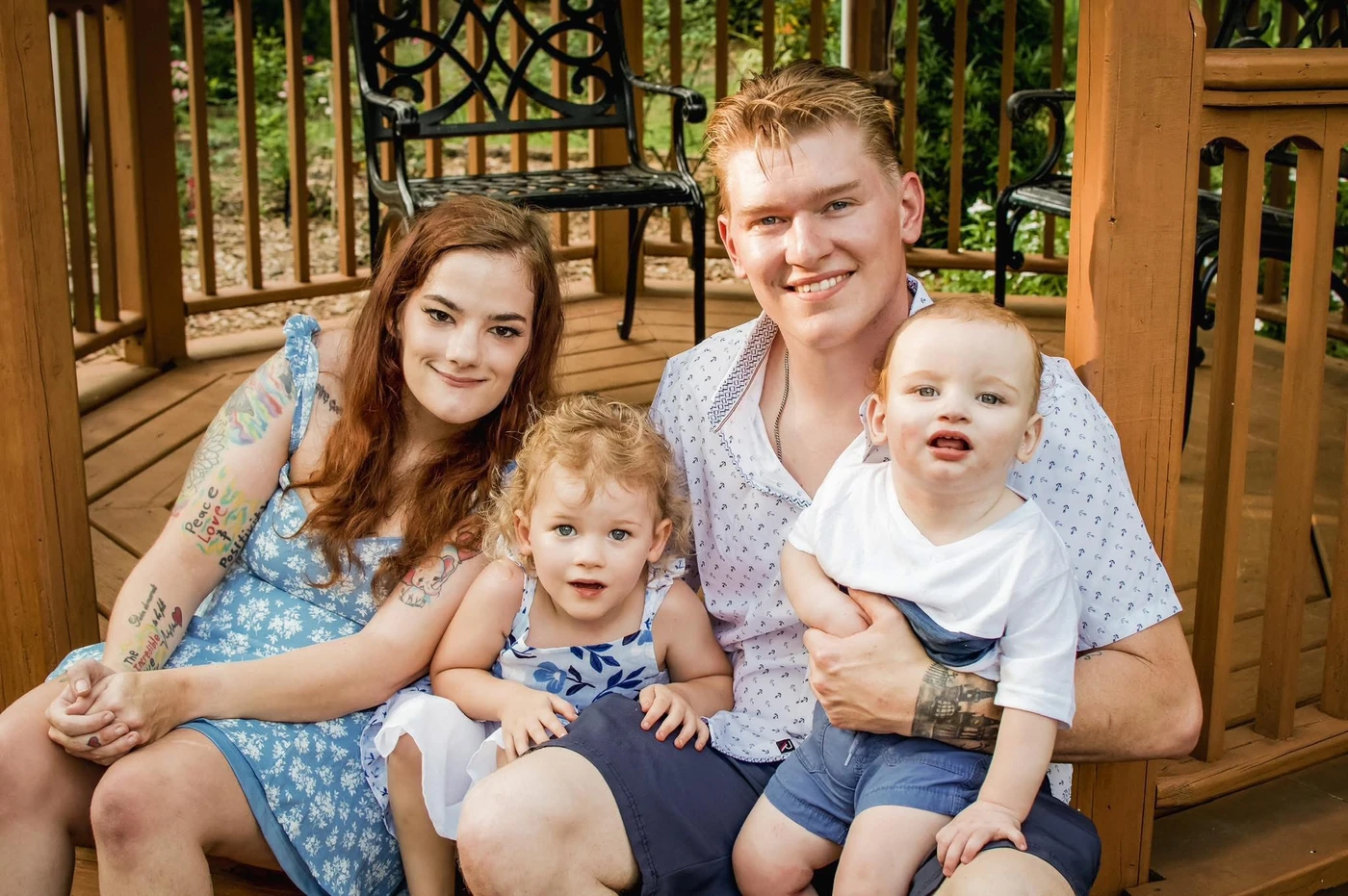
I’m Anna Ferrer—a disability advocate, mom of two, and children’s book author.
I know what it feels like not to fit in. Through my writing and advocacy, I want children and adults with disabilities to feel seen, understood, and welcome—just as they are.
 Ages 4–8 · A story to read together
A curious puppy. A treasure hunt.
A place for every friend.
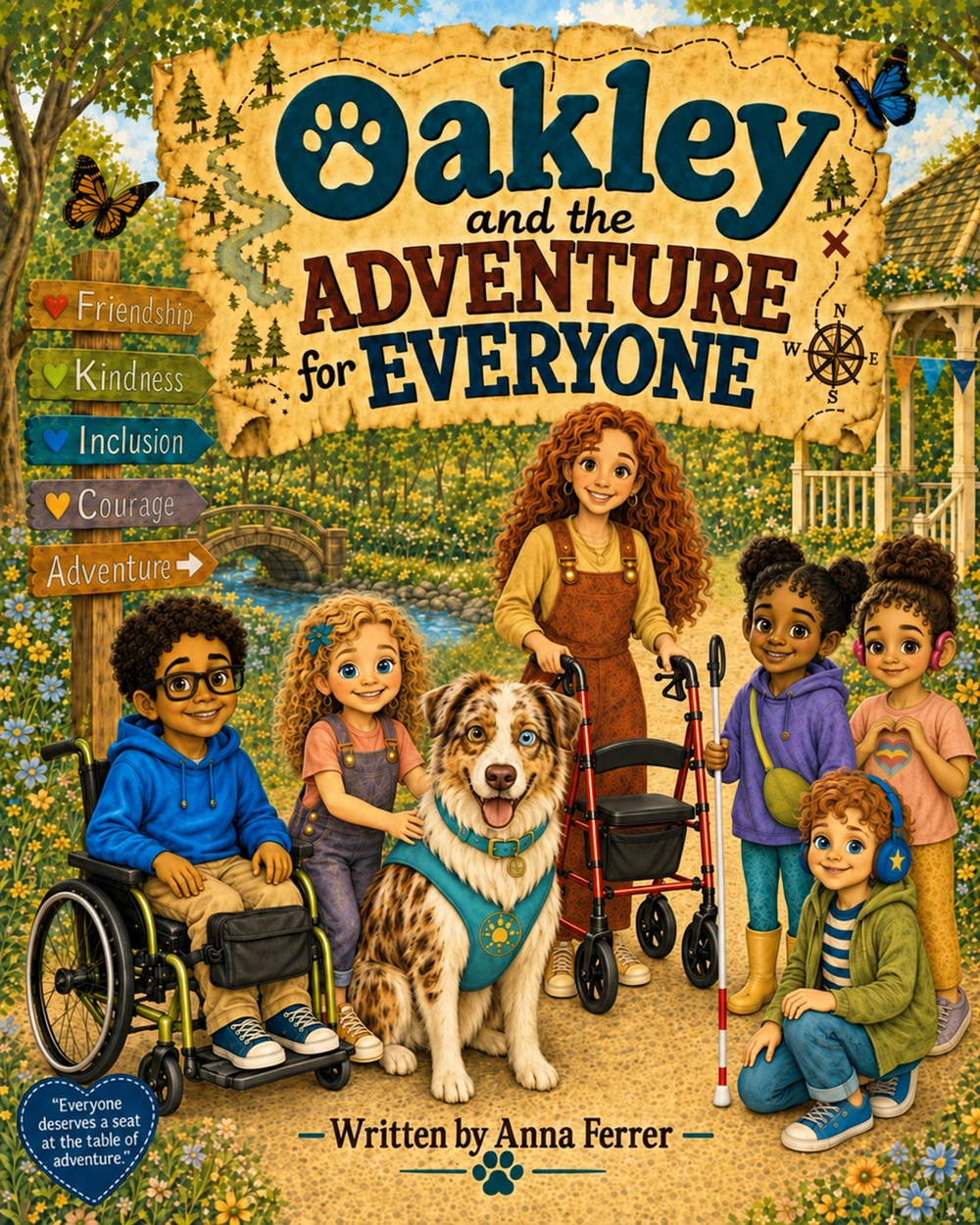
Oakley, a playful Australian Shepherd, joins his best friend Alaia and a group of friends on a treasure hunt created by Alaia’s mom, Mia, who has cerebral palsy.
When a rocky trail gets in the way, they find a route everyone can use. Along the way, their different abilities become strengths.
With learning pages and Kind Questions, the story opens the door to conversations about disability, accessibility, and friendship.
Paperback available through Ingram.
ISBN: 9798182867979
U.S. list price: $14.99
55% wholesale discount · Returnable
For stocking inquiries or event ideas, contact Anna.
A story about friendship, curiosity, and finding a way forward together.
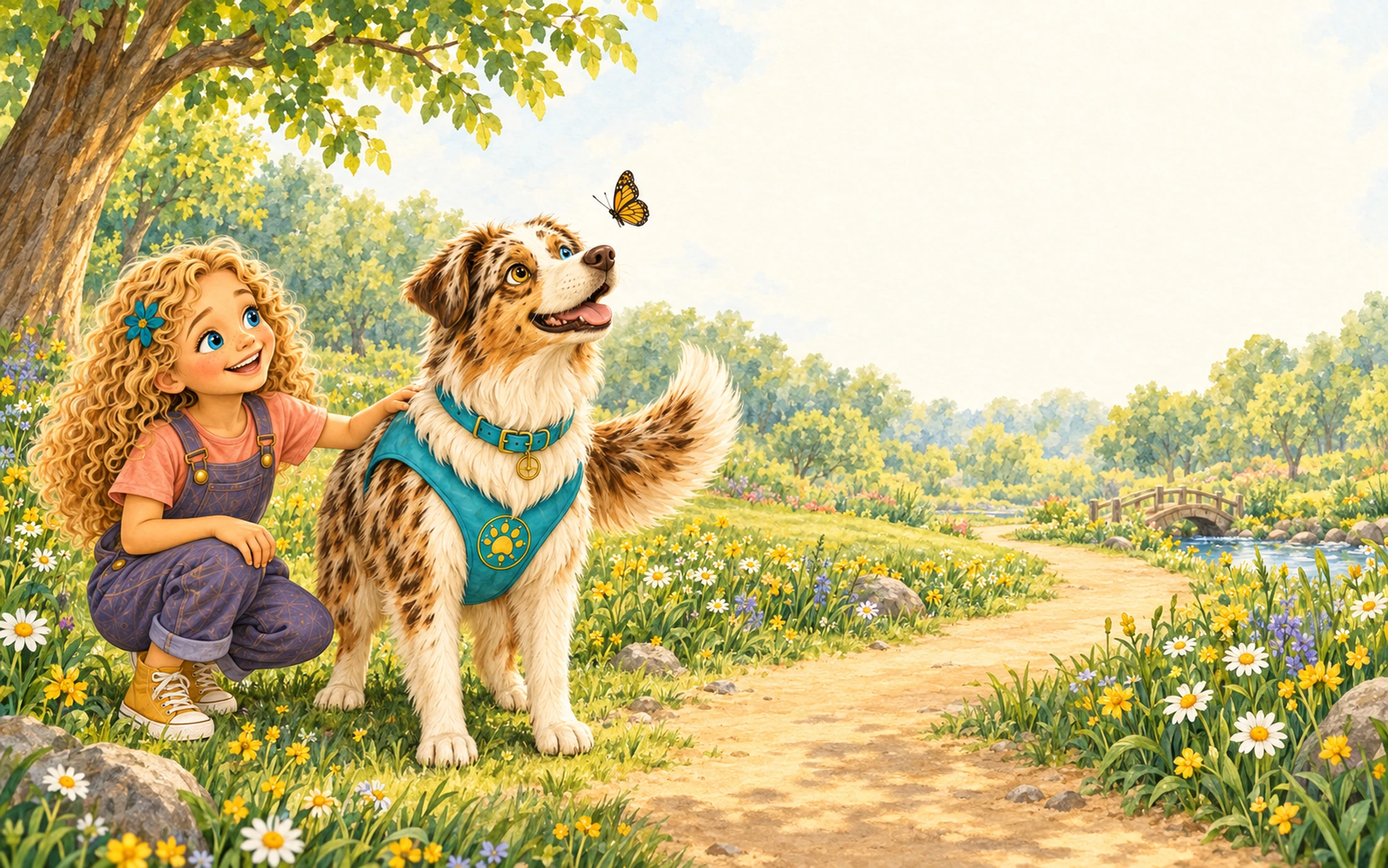
Alaia and Oakley watch a butterfly. Friends begin a treasure hunt, but a rocky path makes them look for a way to continue together. The trailer shows learning pages and Anna’s Author’s Note, then closes with the book cover and a message of belonging. On-screen text; no audio.
My mission
I want to help create a world where disability is understood, differences are respected, and belonging is something we put into practice.
Children deserve to see people like themselves in books and in everyday life. Disabled parents deserve to see themselves as parents who lead, create, and make memories with their children.
Sometimes inclusion means changing a path, adapting the rules of a game, or simply inviting someone to join. Small choices can change how it feels to be part of a group.
Children are naturally curious. I want to give families the words to answer questions about disability with kindness and honesty—and to listen to the person whose experience they’re learning about.
There is always
room for
everyone.
Anna Ferrer
From feeling left out to helping someone else feel that they belong.
Growing up with cerebral palsy, I often felt left out. I want children to see themselves in the stories they read and know they have a place in the adventure.
Now that I’m a mom of two, I think about what I needed to see when I was young—and what I want my children and their friends to understand today. Disability is part of our lives. So are love, laughter, creativity, and adventure.
I wrote Oakley and the Adventure for Everyone to give children a story where they could see themselves and know they belong, too. Mia, a mom with cerebral palsy, creates the adventure. That matters to me: disabled parents bring love, ideas, and imagination to their families, just like other parents do.
My hope reaches beyond the book. I want to help children, parents, and other adults feel less alone—and help communities make room for everyone. I’m sharing that message through book donations, a planned reading with elementary students at LiFT, and my recorded interview with Reading With Your Kids.
If I can give even one child the feeling that they belong, that would mean the world to me.
The Kind Questions page gives families a place to begin. The goal is to make room for curiosity, listen carefully, and turn understanding into everyday inclusion.
A few ways to keep talking
We can ask what would help and adapt the game together. Sometimes a different rule, a quieter space, or a more accessible path lets everyone take part.
Answer simply and kindly: it is a tool that helps someone move through their day. People use different tools, and they can tell us what help—if any—works for them.
It’s okay to still be figuring that out. You don’t have to prove yourself to deserve friendship or to be part of the fun. You belong just as you are.
Conversation starters inspired by the book’s message.
Two illustrated learning pages introduce some of the tools and different ways of exploring that children meet in the story.
Open either page for a closer look and an easy-to-read text version.
Schools · Libraries · Communities · Media
I welcome conversations about author visits, read-alouds, interviews, guest writing, and disability inclusion. If my story or my book could connect with your community, I’d love to hear from you.
Tell me a little about your community and what you have in mind.
Email Anna annaferrerbooks@gmail.comBased in Hudson, Florida
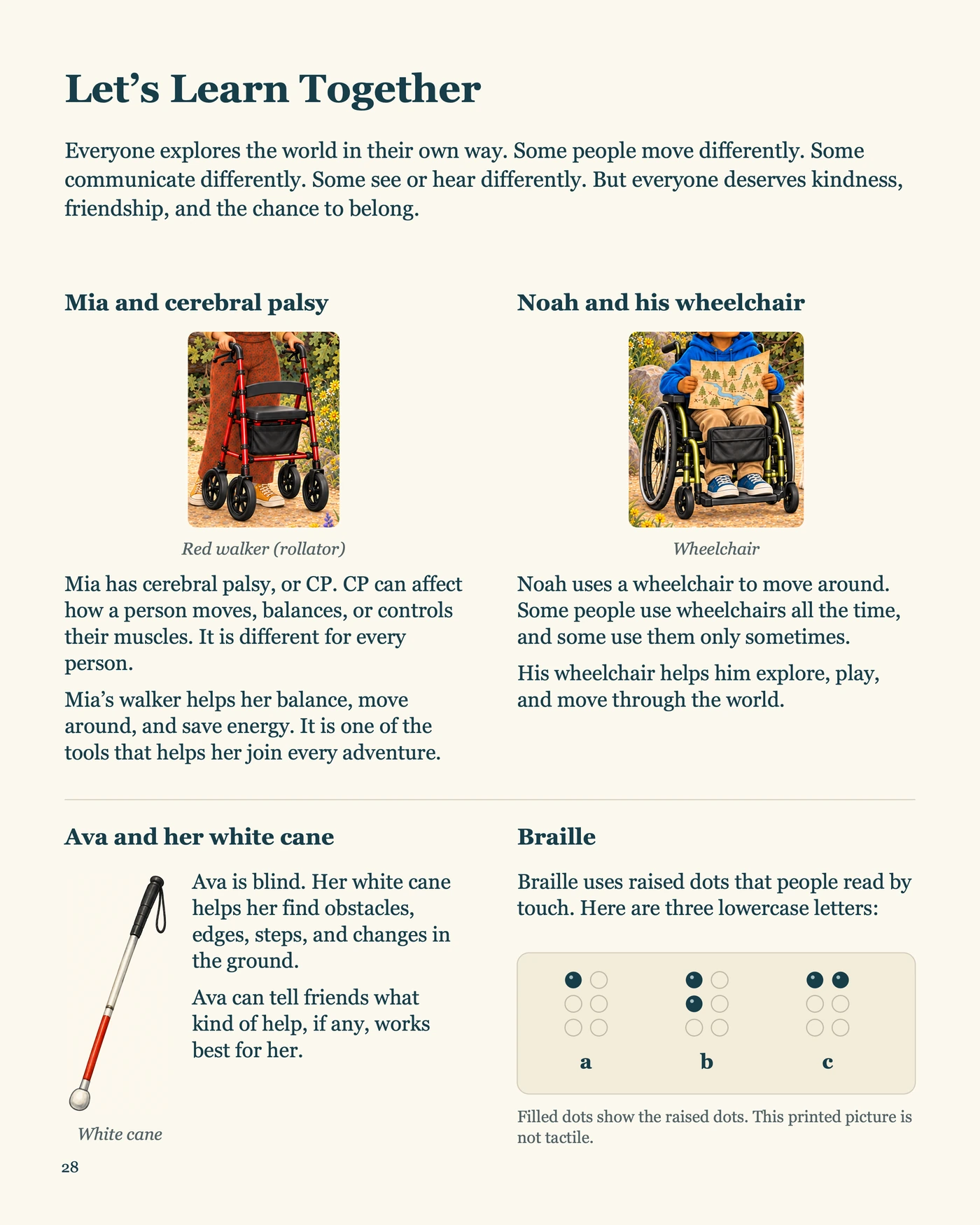
Everyone explores the world in their own way. Some people move differently. Some communicate differently. Some see or hear differently. But everyone deserves kindness, friendship, and the chance to belong.
Mia has cerebral palsy, or CP. CP can affect how a person moves, balances, or controls their muscles. It is different for every person.
Mia’s walker helps her balance, move around, and save energy. It is one of the tools that helps her join every adventure.
Noah uses a wheelchair to move around. Some people use wheelchairs all the time, and some use them only sometimes.
His wheelchair helps him explore, play, and move through the world.
Ava is blind. Her white cane helps her find obstacles, edges, steps, and changes in the ground.
Ava can tell friends what kind of help, if any, works best for her.
Braille uses raised dots that people read by touch. Here are three lowercase letters: a, b, c.
Filled dots show the raised dots. This printed picture is not tactile.
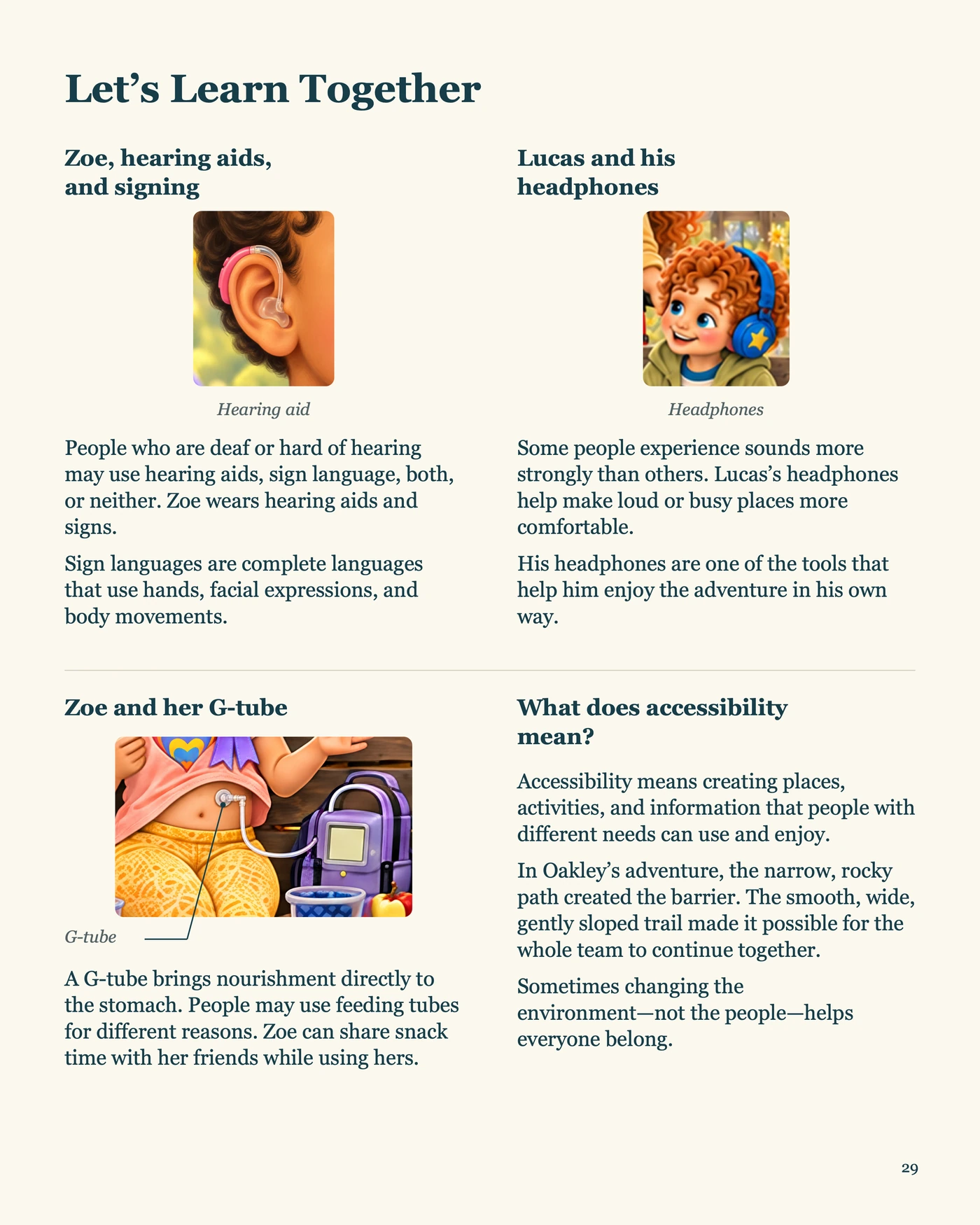
People who are deaf or hard of hearing may use hearing aids, sign language, both, or neither. Zoe wears hearing aids and signs.
Sign languages are complete languages that use hands, facial expressions, and body movements.
A G-tube brings nourishment directly to the stomach. People may use feeding tubes for different reasons. Zoe can share snack time with her friends while using hers.
Some people experience sounds more strongly than others. Lucas’s headphones help make loud or busy places more comfortable.
His headphones are one of the tools that help him enjoy the adventure in his own way.
Accessibility means creating places, activities, and information that people with different needs can use and enjoy.
In Oakley’s adventure, the narrow, rocky path created the barrier. The smooth, wide, gently sloped trail made it possible for the whole team to continue together.
Sometimes changing the environment—not the people—helps everyone belong.
I wrote this story because I have cerebral palsy.
As a mom, I know my daughter and her friends may one day wonder why I move differently or use a walker. I wanted to give children warm, honest words for those questions—and to show disability as a natural part of everyday life.
Oakley and the Adventure for Everyone is not really about disability. It is about friendship, teamwork, curiosity, and making sure everyone has a chance to join the adventure.
Mia is a mom, a problem-solver, and the Adventure Maker. Each explorer brings a different strength. And Oakley reminds us that nobody needs to be the same to belong.
I hope this story encourages children to ask kindly, listen carefully, and notice when a path, game, or plan leaves someone out. We can make a better way together.
There is always room for everyone.
—Anna Ferrer